
IBZ is giving the spotlight to another incredible team of changemakers from the Hack the World: Analyze & Design – RecAbility! Founded by Swaraj Bhowmick, RecAbility focuses on creating accessible recreational tools to assist individuals with limited mobility and dexterity in their athletic pursuits.
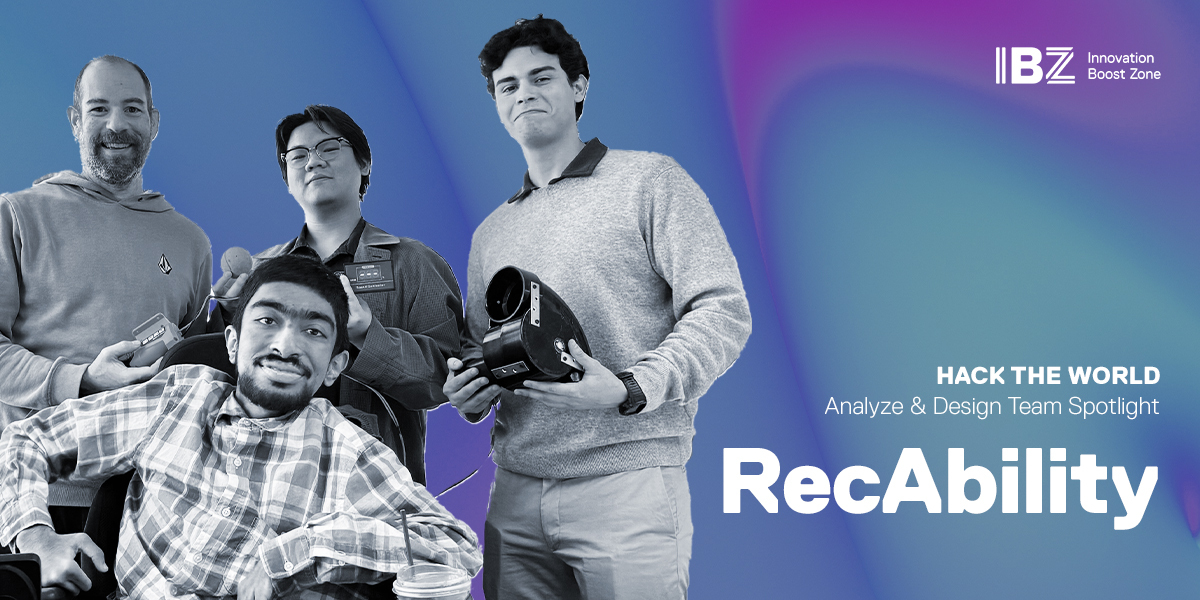
Inspired by his upbringing playing adaptive floor hockey, RecAbility’s founder, Swaraj Bhowmick, began the startup to support people with limited mobility and dexterity in their athletic pursuits. With RecAbility, Swaraj and his team aim to fill the gap that exists in the sports and recreation market. By creating everyday recreational products, the company seeks to make sports and recreation more accessible.
The notion of the everyday user is a leading value of RecAbility. Swaraj explains that parasports may be viewed as an opportunity for physical engagement for those with limited mobility. However, he emphasizes that despite their popularity in the wider media, parasports are not a realistic endeavour for most wheelchair users, who do not have the upper-body strength necessary to participate in such a mode of athleticism. As a result, Swaraj aims to create opportunities for the disabled community to engage in exciting physical activities in their day-to-day lives.
One of the first steps in working towards this goal is the company’s current project: prototyping of an accessible ball thrower and retriever, designed for wheelchair users. This first-of-its-kind innovation is designed to help remove barriers and empower people to play fetch with their dogs independently. Even in its early stages, RecAbility appeals to a wide variety of stakeholders, including consumers, rehabilitation centres, hospitals, and governmental institutions, all of which can benefit from the production of accessible recreational devices.
Swaraj and his team have found continued motivation in this endeavour by working with other entrepreneurs through IBZ’s Hack the World: Analyze & Design program. This seven-week intensive incubation program provided the RecAbility team with the support and resources needed to develop their idea and bring it closer to market. Developed with the United Nations’ Sustainable Development Goals (SDGs) in mind, RecAbility’s ball-thrower aims to address global challenges regarding good health and well-being (Goal 3) and reduced inequality (Goal 10).
TMU’s Innovation Boost Zone (IBZ), Social Ventures Zone (SVZ), and Ted Rogers School of Management continue to support RecAbility as the startup works to establish itself as a leader in creating accessible sport and recreation opportunities. As a winner of the 2024 Slaight New Venture competition, RecAbility received $25,000 to work towards business development.
If, like Swaraj, you have a game-changing idea that tackles current issues, be sure to check out the Innovation Boost Zone to learn how you can gain support to turn this dream into reality.
Hack the World: Analyze & Design was the second program in a series of three innovative experiential learning opportunities hosted by Innovation Boost Zone. In this phase, four student-led teams from TMU engaged with their stakeholders and worked with field experts to gain new insights and deliver a product or service to provide solutions to real-world problems. This hackathon provided students with a clear runway to success, bolstering them to evaluate and test their ideas and make a positive impact.
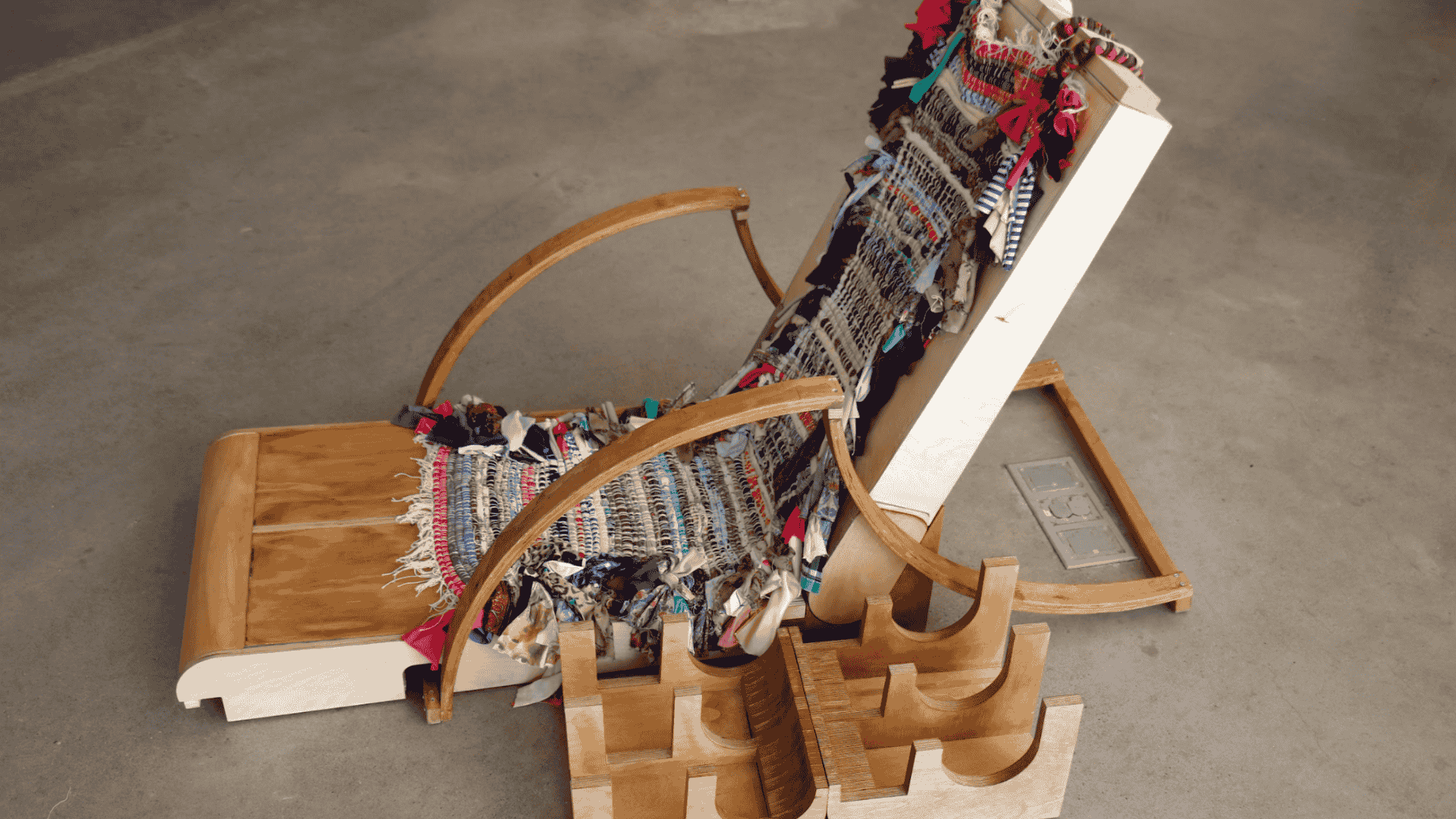
The competition was fierce, featuring standout finalists who pushed the boundaries of sustainable fabrication. Notable projects included TREAD / 01 (by Myrah Mohammed and Lynn John-Koshy), The Helitack Chair (by Thalia Arkuszewski, Gavin Brown, and Joey He), Taking the Edge Off (by Emma Wood, Alicia Unwin, and Kaylee Mikalauskas), and Λlcove (by Enakshi Chatterjee and Riddhi Bilakhia).
At the heart of Reclaiming Future was a commitment to sustainability as both a mindset and a method. Students were encouraged to think critically about consumption, waste, and design lifecycles, engaging directly with principles of circular design. Rather than seeing materials as disposable, they were challenged to view them as resources—full of untapped potential.
This transformation didn’t happen in isolation. The project was supported by the Design Fabrication Zone at the Student Learning Centre, an accessible makerspace where students gained access to tools, training, and mentorship. For many participants, this meant stepping into entirely new territory—learning how to safely operate equipment, experimenting with fabrication techniques, and translating conceptual ideas into tangible forms.
For competition winner Nehir Korkmaz, the structured support was a highlight of the experience.
"Workshops were very well planned, and everyone involved was highly knowledgeable," Korkmaz shared. "I learned a great deal throughout the process thanks to these workshops. They not only helped me with this competition, but also gave me valuable knowledge for my future studies."
That learning curve became a central part of the exhibit. Students weren’t just creating final products; they were building the confidence to lead the next generation of sustainable design.
What made the showcase particularly compelling was its emphasis on narrative. Like in a fullbodied art exhibition, each piece invited viewers to reflect on its journey: Where did this material come from? What idea does it convey? And what might it become next? In this way, Reclaiming the Future extended beyond a showcase—it became a conversation about how we assign value, and how we might rethink our relationship with the objects that surround us.
Ultimately, Reclaiming the Future was a reminder that meaningful climate action doesn’t always begin with sweeping changes. Sometimes, it starts with a single material, a new skill, or a shift in perspective. With the right support and space to explore, those small beginnings can grow into something transformative.
At TMU, that transformation is already underway: one project, one story, and one reclaimed future at a time.


