
This International Women's Day, Innovation Boost Zone is honored to feature an inspiring entrepreneur who is making a tangible impact—Saina Khoshdouni!

This International Women's Day, Innovation Boost Zone is honored to feature an inspiring entrepreneur who is making a tangible impact—Saina Khoshdouni! A graduate of the Master of Engineering Innovation and Entrepreneurship (MEIE) program and Stage 3 winner of the latest Norman Esch Awards cohort, Saina is the founder of ShieldMate, a groundbreaking venture dedicated to supporting individuals experiencing intimate partner violence. Through discreet, accessible, and tech-enabled solutions, ShieldMate aims to empower survivors and provide them with the resources they need to regain safety and control over their lives.
We spoke with Saina to learn more about how ShieldMate came to be, what empowers her work, and the lessons she learned on her entrepreneurial journey.
A little bit about my own background. I studied computer engineering back home in Iran and moved to Toronto to do my Master's Degree in Engineering Innovation and Entrepreneurship here at Toronto Metropolitan University. Upon my immigration to Canada, I started my very small social circle, but unfortunately, the sad news is that among that very limited circle, I had a few individuals and acquaintances of mine experiencing intimate partner violence. Either in a marriage setup or with their intimate partner. I felt like something needed to be done about that. That's how the idea of ShieldMate originated, with a desire to provide a tool that would empower these individuals.
Just in terms of ShieldMate, knowing that I can make a real impact on the lives of people who are the most vulnerable, is what drives me on a daily basis to work on this project. Also knowing that you belong to a community of like minded entrepreneurs, that other people are also experiencing the same hardships and struggles that you have to face as a founder.
Due to the nature of our industry and working on something that is specifically focused on supporting many female victims of intimate partner violence, we had a lot of female champions and survivors coming forth and speaking about their experience, which was monumental in what approach we would take and how ShieldMate should be built. Having female mentors and fellow founders within the IBZ community was also extremely helpful in building morale and taking all the necessary steps on this journey.
What I'm currently learning is that success as we might define it is not necessarily about luck. It's one portion of preparation and maybe three portions of resilience. You have to be very resilient and hear a lot of no’s to make it and refine yourself to be successful. What I would tell my younger self is to trust myself, trust the idea, and stop delaying the whole process with obsessive perfectionism. Don’t try to make the solution perfect, aim to go to the market as soon as possible.
I am just hopeful that we will be able to see a significant potential impact in helping these vulnerable people who are experiencing domestic violence, getting them to a haven where they're safe and out of that traumatic situation. Just knowing that we can change the lives of people who are experiencing something that no one should be experiencing, would be my highest hope.
Please take a step forward. We don't have that many women entrepreneurs representing in the entrepreneurial world and this ecosystem. But hopefully with more female founders taking initiative we will be able to change that balance.
My connection and exposure to TMU initially was through the Master of Engineering Innovation and Entrepreneurship program, which has played a significant role in helping me start the journey. And winning The Norman Esch Awards was just amazing, as I got awards on all three stages. Of course, the funding is really helpful, but it wasn't just that. It was also the validation, mentorship and support we got in finding the right solution.
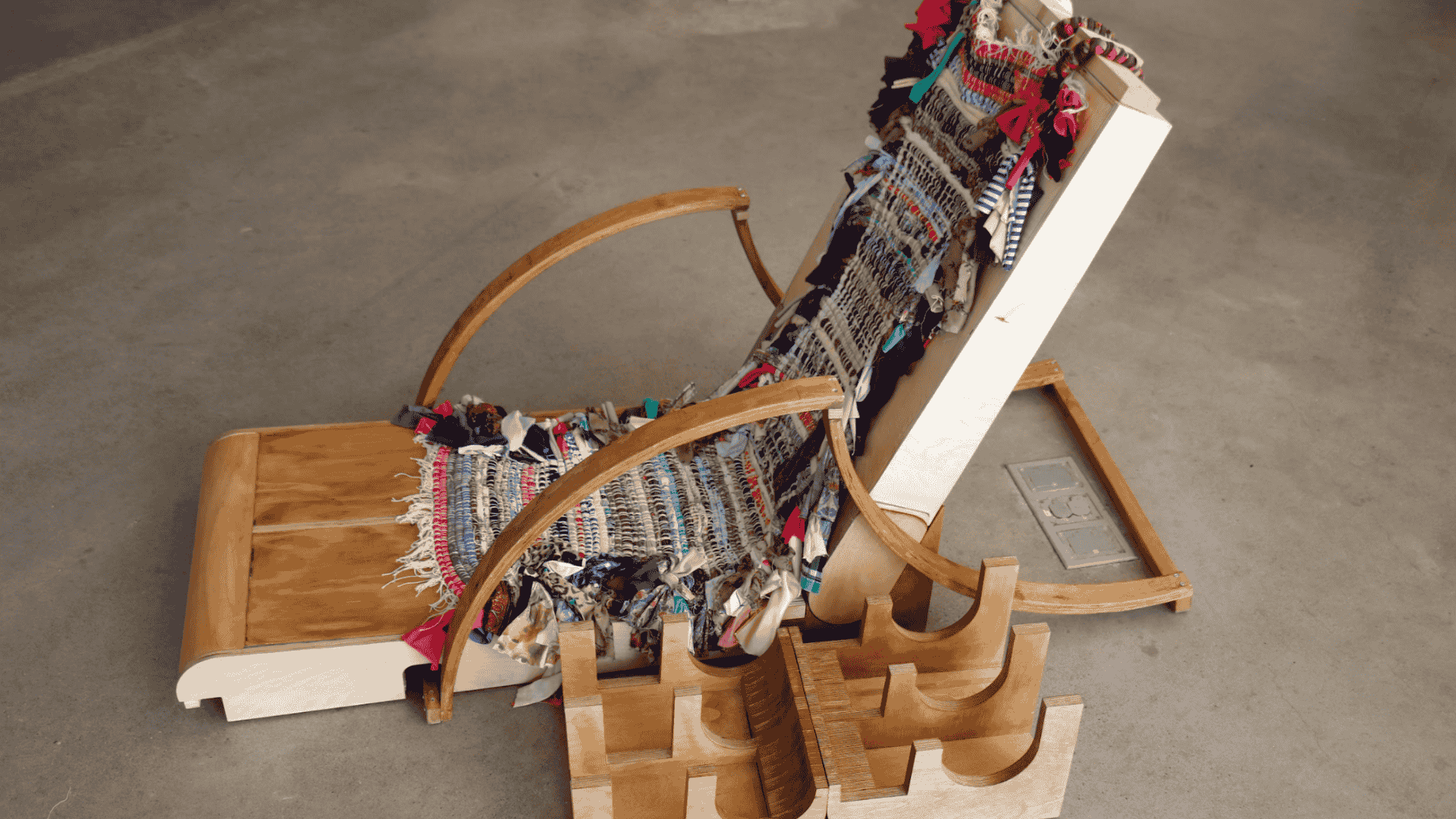
The competition was fierce, featuring standout finalists who pushed the boundaries of sustainable fabrication. Notable projects included TREAD / 01 (by Myrah Mohammed and Lynn John-Koshy), The Helitack Chair (by Thalia Arkuszewski, Gavin Brown, and Joey He), Taking the Edge Off (by Emma Wood, Alicia Unwin, and Kaylee Mikalauskas), and Λlcove (by Enakshi Chatterjee and Riddhi Bilakhia).
At the heart of Reclaiming Future was a commitment to sustainability as both a mindset and a method. Students were encouraged to think critically about consumption, waste, and design lifecycles, engaging directly with principles of circular design. Rather than seeing materials as disposable, they were challenged to view them as resources—full of untapped potential.
This transformation didn’t happen in isolation. The project was supported by the Design Fabrication Zone at the Student Learning Centre, an accessible makerspace where students gained access to tools, training, and mentorship. For many participants, this meant stepping into entirely new territory—learning how to safely operate equipment, experimenting with fabrication techniques, and translating conceptual ideas into tangible forms.
For competition winner Nehir Korkmaz, the structured support was a highlight of the experience.
"Workshops were very well planned, and everyone involved was highly knowledgeable," Korkmaz shared. "I learned a great deal throughout the process thanks to these workshops. They not only helped me with this competition, but also gave me valuable knowledge for my future studies."
That learning curve became a central part of the exhibit. Students weren’t just creating final products; they were building the confidence to lead the next generation of sustainable design.
What made the showcase particularly compelling was its emphasis on narrative. Like in a fullbodied art exhibition, each piece invited viewers to reflect on its journey: Where did this material come from? What idea does it convey? And what might it become next? In this way, Reclaiming the Future extended beyond a showcase—it became a conversation about how we assign value, and how we might rethink our relationship with the objects that surround us.
Ultimately, Reclaiming the Future was a reminder that meaningful climate action doesn’t always begin with sweeping changes. Sometimes, it starts with a single material, a new skill, or a shift in perspective. With the right support and space to explore, those small beginnings can grow into something transformative.
At TMU, that transformation is already underway: one project, one story, and one reclaimed future at a time.


